Mark Verification
Tools ▸ Mark Verification · ◆ Black
What it does
It confirms that an engraved code reads back as the thing it was supposed to be — and pass/fails it.
Engraving a serial number or a QR code is only half the job when a customer requires traceability. The other half is proving each part carries the right one.
⚠ Read this before planning a workflow around it
The live camera read is not wired yet. The panel says so: "Live carriage-camera QR read is hardware-gated."
In practice that means the decoded value is entered or pasted by you — from a handheld scanner, a phone, or by reading it. The comparison, the pass/fail logic and the batch reconciliation are all real and working; the automatic reading step is the part waiting on hardware.
⭐ That is still genuinely useful — reconciling a hundred scanner reads against a dataset by hand is where the errors creep in, and that is the part this does. But do not sell or plan it as a hands-off inline vision check, because today it is not one.
Single mark
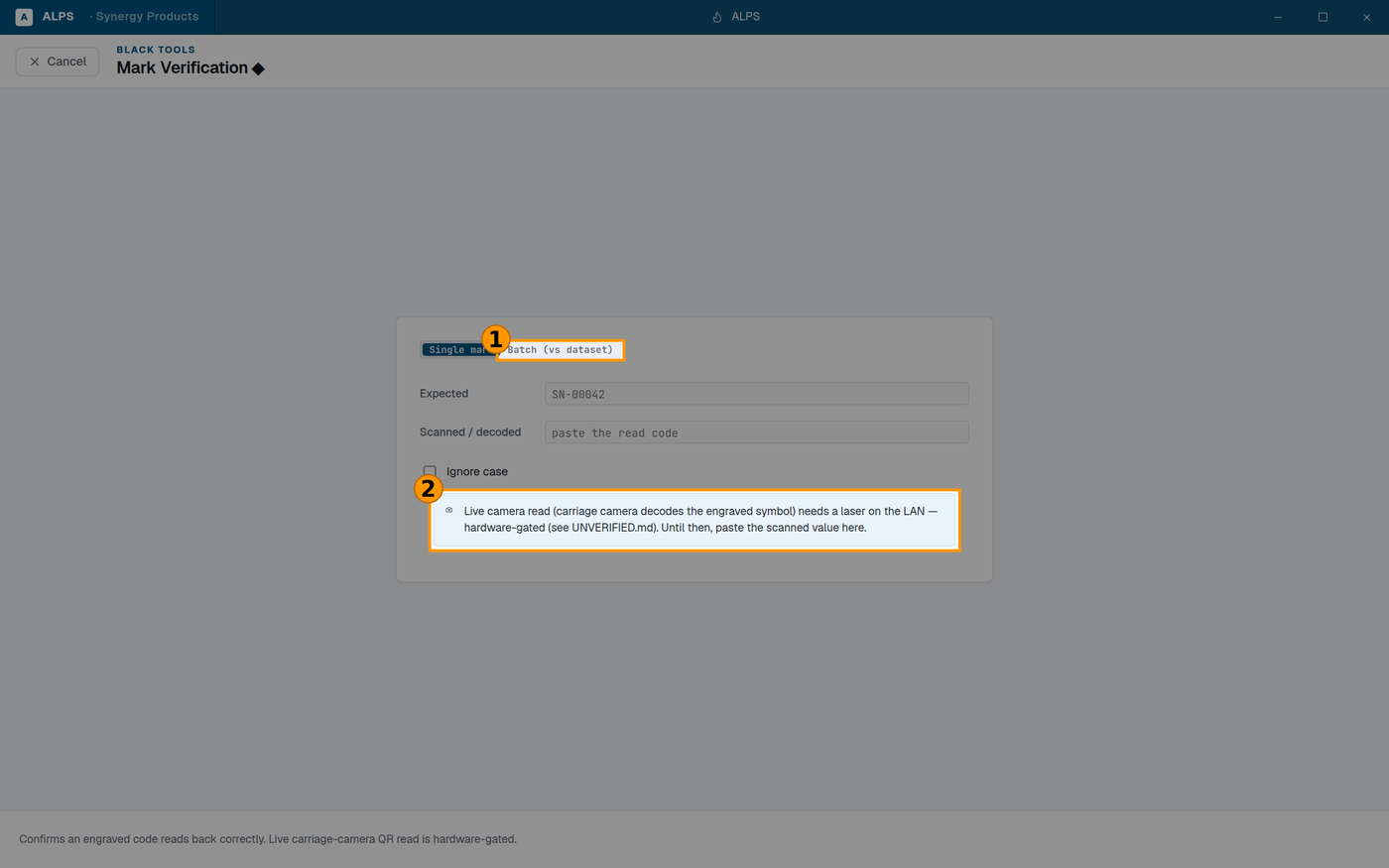
① Batch reconciles a whole run against your dataset — it finds the part that got SKIPPED ② The live camera read is hardware-gated — today you paste what your scanner read
For checking one part.
- Expected — what should be there.
- Scanned / decoded — what was actually read back.
- Ignore case if the difference does not matter for your part numbering.
It reports pass or fail on an exact comparison.
Batch (vs dataset)
This is the mode worth learning, and it pairs with Variable Data.
When you engrave a run from a spreadsheet, that spreadsheet already holds every value that should exist. So:
- Choose the Expected column holding the values that should exist.
- Scan every part and paste the reads in — one per line, or comma-separated.
- ALPS reconciles the two lists.
⭐ The reason this beats checking parts one at a time: it finds what is missing. Verifying part by part tells you each part you looked at is fine. Reconciling against the dataset tells you serial 47 never got scanned at all — which is the failure a per-part check cannot see, because the part that went missing is the one nobody had in their hand.
⛔ Verification is not a substitute for a test run
A code that fails verification has already been engraved onto a part. On a run of five hundred, that is five hundred parts before anybody finds out.
⭐ Scan the first part off the machine before running the rest. Then use this to confirm the batch, not to discover a problem you could have caught in the first thirty seconds.
Related
- QR / Barcode (
qr-barcode.md) — generating the codes. ⚠ Invert for dark materials is the most common reason a code will not read at all. - Variable Data — where a batch's expected values come from.